


A recent study found that procrastination affects not only our daily activities, but also our sleep patterns and, as a result, our health. Scientists from Utrecht University in the Netherlands surveyed 177 men and women about their sleep habits, lifestyles and procrastination levels.
Their findings, published in Frontiers in Psychology, suggest that “bedtime procrastination” is a more widespread, harmful problem than anyone thought.
Sleep procrastination is characterized by a person’s failure to go to bed at the intended time, even though no external circumstances prevent them from doing so. Even after one night, it “can lead to decreased cognitive function, trouble concentrating, headaches and general moodiness,” says Dr. M. Safwan Badr, former president of the American Academy of Sleep Medicine (AASM).
Because even a single night of sleep procrastination can seriously affect your ability to function, it’s important to eliminate activities and distractions that can keep you up or tossing and turning through the wee hours.
So, how can we avoid sleep procrastination and the issues it could cause? Here are four tips to help you go to bed on time:
1. Keep Your Eyes Off Screens
When scientists researched the sleep habits of current pre-industrial societies living in Africa and Bolivia, they found that nearly no one suffered from insomnia. In fact, they found that the people in these cultures nearly never napped or set any sort of designated sleep schedule. And although there are probably many reasons for this, one is likely that there are less technological distractions available to pre-industrial peoples.
Research shows being on screens-whether it’s a TV, phone or tablet-before bed can negatively affect sleep. Watching exciting programs before bed may cause you to “stay up longer, and be more engaged, than is ideal for [your] schedule,” suggests Dr. Badr. Combine an overstimulated brain with light and volume variations and you have a recipe for sleepless nights.
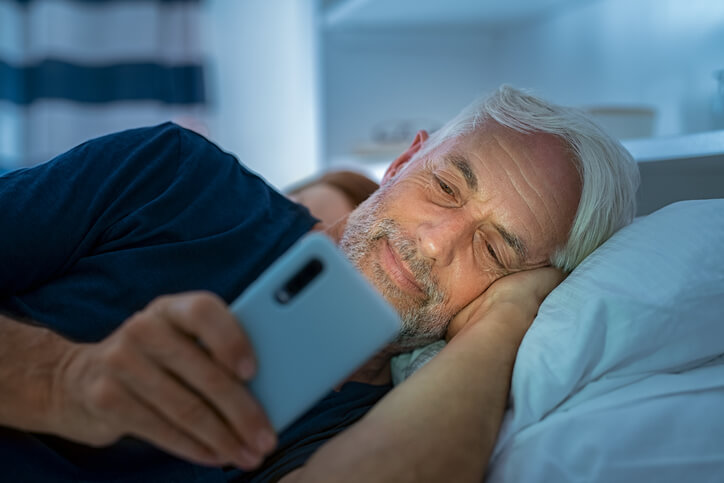
Another issue impacting sleep: the ease of streaming. The auto-play feature of streaming services like Hulu, Netflix and Amazon Prime can be very unhealthy when it comes to prioritizing rest. Binge-watching your favorite show can be a great way to spend a rainy Saturday, but it should be avoided before bedtime.
The solve? Dr. Badr suggests using your bed for sleeping only, meaning leave the technology at the door. Even better, do your best to avoid looking at any screens for at least 90 minutes before going to bed. Trade in your Kindle or iPad for a real book while you’re in bed to sleep more restfully through the night. Avoid “watching TV late at night so you have enough time to conduct a wind-down routine… that doesn’t involve any screens.”
Tip: If you’re an avid TV-streamer before bed, disable auto-play to make sure you’ll get to sleep on time.
2. Set a Routine
Dr. Badr notes that over the long-term, “sleep deprivation can result in significant impairments in cognitive and motor performance,” which increase the risk of automobile, work-related and fatal accidents. Building a wind-down routine for the hours before you go to bed can help you avoid sleep deprivation and the bad habits that cause it.
Select a time at which you’ll go to bed every night and create a routine for how you’ll spend your last hour before bed. Make sure the activities you “schedule” relate to sleeping and help you wind down. This can be anything from journaling to stretching to taking your time brushing your teeth and washing your face.
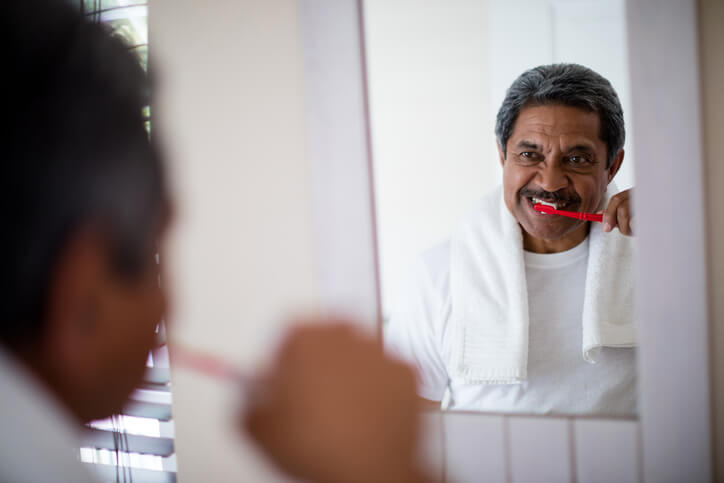
For a truly effective sleep routine, Dr. Badr suggests keeping “a regular sleep schedule, as you would for your child,” and “making your bedroom quiet, dark and a little bit cool” before bed.
3. Get a Real Alarm Clock
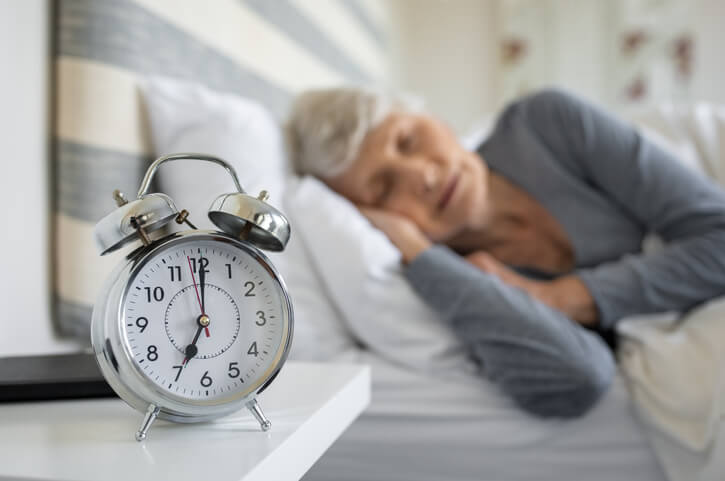
Yes, the one on your phone works, but having your phone next to your bed might entice you to check one more message or answer one more email. This can stimulate your brain and keep you awake longer. If you need to use your phone as an alarm, says Dr. Badr, “keep the phone beyond arms reach” to help you avoid the urge to check email or browse apps.
4. Practice Mindfulness
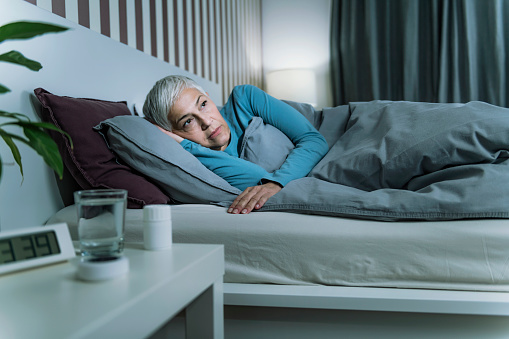
It’s easy to get caught up in the chaos of daily life, especially as we hit the sheets for the night. But making a habit of practicing gratitude can help train our brains to notice the positive rather than focusing on the negative aspects of life, right as we drift to sleep.
Feeling gratitude on a regular basis can not only lead to a better night’s sleep, but also boost immunity and reduce risk for depression and anxiety, according to the Mayo Clinic. Taking time to be grateful may also lower the risk for disease and help ease chronic pain.
To get started on your gratitude practice, all you need is a spiral notebook and a few minutes in the evening. Write down five to 10 specific things you’re grateful for. Your gratitude list might include items small or large, such as “I’m grateful that the sun was shining today,” “I’m grateful for my good health,” or “My coffee this morning delicious.”



If I wake up and cannot go back to sleep, I start reading my bible and that will put me back to sleep.
Can you suggest me how can I get good sleep?
What do you suggest for those of us who fall asleep but wake up an hour or two later and can not get back to sleep for an hour and a half to two hours?
Marvin,
Check our article on How to Fall Asleep Fast and Sleep Better. Maybe there are some tips in there that could help. Sweet dreams!
To reach sleep, I turn off my mind using the alphabet. Starting with a certain subject list the words of: food, animals, flowers, colors, etc. Most of the time I don’t reach z before I fall asleep
I sieep 6 to 7 hours per night . I drink a cup of tea about thrity minutes before going bed.
I have a very scattered work schedule so setting a “routine” is almost impossible. Mon work begins at 12:30pm, Tue 9:30am, Wed 7:30am, Thu 5:30am, and Fri 6:30am. So I’m free about 9 hours post start time each day. Some nights “bedtime” is earlier than I’m even out of work other nights. Suggestions on creating good sleep habits in THIS situation?
1. RELAXATION EXERCISE: as you lie in bed, start slow, deep breathing releasing all the things in your mind with each large exhale. Next, imagine your favorite beach with huge waves rolling in and out in time with your slow, deep breathing — you’ll literally feel yourself start to relax. Further, as others have suggested, repeat the Lord’s Prayer over and over, “syncing” the prayer with your imagined waves in tune with your breathing.
2. If you have lots of things on your mind, get up and out of bed, go to the place in your home where you conduct business, and write all the stuff in your head on a sheet of paper. Now, your mind tells you that the issues are “stored” to be addressed at a later time and your mind “clears”.
3. No alcohol, caffine, nicotine or aerobic exercises prior to bedtime.
4. As others have suggested, no TV in your bedroom — works wonders!
5. And finally, if you have some really bothersome/nasty issues, start a written “Nasty List” and place all the nasty issues and people on the list in a drawer — “out of sight, out of mind”!
I’ve been retired for many years, so can freely indulge in my night owl tendencies. What works well for me is being read to on my Kindle Fire. Books from the public library are free and can be downloaded over wifi from home. The checkout is for 21 days, and I tap the timer for 15 minutes–sometimes more than once. I don’t want to get caught up in a mystery so usually stick with nonfiction, including recently some wonderful biographies: Elizabeth the Queen, Becoming, and Homework (Julie Andrews). It’s easy to back up the next night to hear the part you’ve missed!
As a Veteran of the Vietnam conflict I learned quickly that nighttime was the time I needed to be most vigilant. I served as a Sentry Dog Handler and sleeping would have had costly consequences so my Sentry Dog, Chieftain, and I were on top of our game at night because we had to be. When I came back to the World, as we called it then, I had to leave my best friend behind, who saved me from not only snipers but insanity, and that made the situation worse. Suddenly I was thrown into a so-called “civilized” environment that hated us for our service that, as 18 year old youth we thought when going was what we were supposed to do – and upon our return were condemned for it. My subsequent duties went into a continuing career in Law Enforcement, which while as a K-9 officer helped but later while serving in Judicial Corrections as the midnight shift supervisor we continued nightime service so after nearly 30 years of this I don’t need to tell you being nocturnal was ingrained into everything I did. I grew up as a Bush Alaskan watching her turn from being a Territory to a state, so the more recent electronic trends didn’t affect me as it has the modern generations, but the forced reality of remaining alert at night has had it’s consequences. It was my Wife who, as a part of my generation understood the acute difficulties I faced coming home after my time in service offered the solution for me. One was her support for me always having a big dog in our life – she knew the connection I needed and though loving a beautiful home was wonderful about allowing me that comfort in our home in the form of a big German Shepherd curled up next to our bed at night. That was the first big step allowing me to finally adjust to “civilian” life. The second was in recognizing that most of what I was struggling with was nervous tension and that my neuropathways needed rebuilding, so she suggested taking Lecithin – which in my case I’ve found the Sunflower Lecithin to be most effective – to rebuild the nervous system’s commo lines. The effect was very beneficial, to the point that I went from getting little to no sleep at night, to finally sleeping like a normal person. I follow the rest of the recommendations you’ve outlined in the article, while also being physically and intellectively active. I kayaq, design and build boats, I’ve written a Sci-Fi book based on my Native American culture and a later archeologistical article on ancient Pacific maritime migrations, school myself in continuing forms of educational endeavors such as Yacht design and Scripture, among many things of an uplifting nature, and rely greatly on the gifts of God – one of which is my Service Dog, Beaufort, a wonderful Yellow Lab who is so full of happy I can’t stay disgruntled, no matter how bad my day is. We have a saying as K-9 officers – “What goes down the leash, comes up the leash.” But in his case, what goes Up the Leash cheers the Skipper, and I thank our God for that blessing – and my understanding Wife who believes in me. All in all, life has finally developed in a more positive role for me, but it hasn’t come easy. That’s what makes your article so timely and important – Thank you. – WKBD
Thank you so much for your service! You so beautifully described the joy a dog can bring to someone’s life!
I too have difficulty falling asleep, but do so when I wake up during the night. Then I cannot shut my mind off in order to fall back asleep. I used to never have a TV in my bedroom and still do not have my phone by my side. Always left in the living room.
Now that I do have a TV, I will only try to use it for soothing music so when the time it set, it will shut off on its own.
Just need to work on shutting off the mind (thoughts) at night.
I, too, am a night owl and do not really function well before noon although when I was still working I did force myself to get out of bed at 9am and then to the office by 11am. At night I have to have the TV on in order to sleep at all but I have old Perry Mason episodes on my DVR that allow me to listen without being energized like some modern day series do. Rarely loud noises and I put the sound down low and the TV goes off automatically at whatever time interval I set it at. But I do agree about the screen time. I get to sleep a little bit earlier and quicker when I shut off the laptop by 10pm. But I still don’t fall asleep until 12am-1am and wake up anywhere from 7am to 10:30am depending on how poorly I slept. The worst is waking up after 4-5 hours sleep and not being able to fall back to sleep for an hour or more or, occasionally, not at all. The latter is the worst. The day is worthless for me. I am unable to nap so that is not a solution.
Very helpful…
I have all the items in my room and suffer with getting to sleep and staying asleep! This is fantastic advice. As of this day, I will make the decision to remove all or as many of the gadgets mentioned. Also, regardless of the time 8pm or 9pm, I awaken so early and can’t get back to sleep.
I love to read in the morning…but at night a different energy arises. Reading print at night makes me restless. However, watching a relaxing movie on my laptop with earphones relaxes me…gets my mind off current problems, concerns. exs: Madmen, The Amazing Mrs. Maisel, a movie last night called “Juanita.” Not violent films before bed.
Hi Maria, this is a great idea for those that find their eyes growing tired while reading at night. Thanks for the advice!
I have Audible on my Kindle Fire. I listen to my current book, but set timer for 15 or 30 minutes, depending on my state of relaxation. I almost always fall asleep before the timer turns Audible off. This has really helped. No lights, no falling asleep with a book in hand this losing my place, and my sleep is good.
Thanks for sharing your experience, Kerrill! This can definitely help others while falling asleep.
My entire family with the exception of my mother are “night people”. I am nonfunctional before 12:00 noon. My goal is to sleep by 4:00 a.m. and sleep until 12:00. Getting up earlier is a waste of time because I just can’t seem to get it together. I’m retired now but when I was working, I chose the second shift, 3-11:30. When I do have insomnia, unable to sleep at all, reading does help. I may try the biblical passages that have been suggested. I reality is that I will never be a in bed by 11 and up at 8 a.m. person.
The reason for writing this is to remind the world that some of us are by nature, night owls.
Very helpful tips, but I am having no problem going to sleep.
This isn’t the first time I’ve heard this information so I will definitely take it to heart. I have a love for books and I read every day (not just on my phone). I will make some changes starting today (baby steps) by limiting my screen time on all devices. I usually talk to God while I’m lying in bed and I recite Bible passages because I do sometimes suffer from sleep issues. Excellent article and I appreciate all the feedback.
In my personal life I need to sleep minimum 7 hours a day to feel fresh and ready for work
When I retired, I moved to another town, changed my sleeping habits.
I go to bed around the same time every night, 10 – 10.30pm, I do not have a tv in my bedroom and I do not have my iPad or iPhone with me.
I get into bed and go to sleep, usually sleep through the night, I have been doing this for 8 years and it works!!…well, for me…great advise…thanks
Thanks for sharing, Jan!
I am pretty good at most of these tips but find lately I have gotten a little lax, and it shows in my sleep quality. Thank you all for your great suggestions.
Thanks for reading, Pam!
First, I thank God for all my blessings and help he gave me today, then I pray for those on my prayer list, then I pray for things I need his guidance on, to help me make right decisions. Then I pray for whomever, whatever pops into my mind (i.e. storm victims, floods, mud slides, missing people. countries in trouble, world peace, etc.} I often go to sleep while finishing my prayers.
I read the 91st psalm before I go to bed each night.
I found this very helpful, and some of the noted suggestions are exactly the kinds of behavior i too practice. I am going to make a conscious effort to try to wind down, not have my screen on late or lower the lights, as i am not comfortable sleeping in the dark since i was a child.
Thank you for this information.
Good advices!
Good information! I too have used the Lord’s prayer and the 23rd Psalm. I read good western books by authors like Louis lemour, sometimes falling asleep very soon.
The one and only thing that gets me to sleep is to read before I go to bed. I fall asleep immediately when I do this.
Plan to read a book an avoid phone. Already have a set time for bedtime when tv is off. Good suggestions.
Thank you for reading, Martha!
Thank you I will try this. I’m moody now though from lack of sleep.
Excellent information to help with sleep. I always find prayers help when I have trouble falling asleep. Sometimes saying the Lord’s Prayer over and over and over until I’m asleep.
Very timely article. I have already started practicing these routines and know that they do work. A lesson learned late in life.